
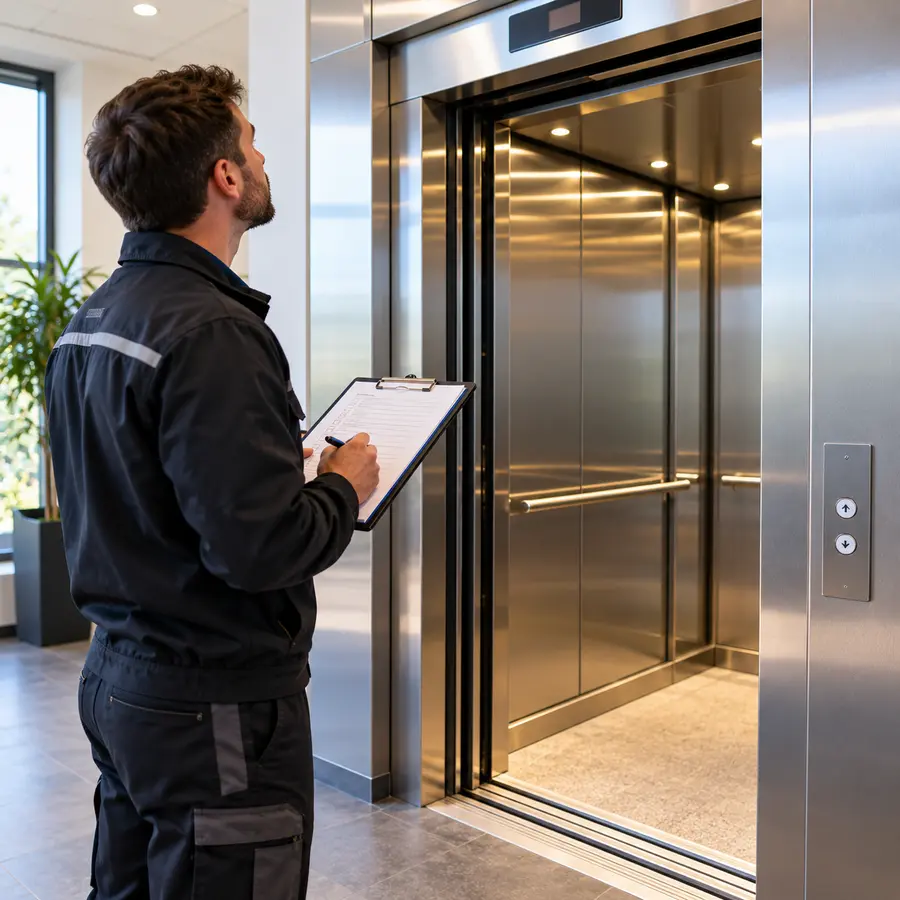
Taking responsibility for a building often means inheriting equipment that you did not specify, install or previously manage. If the property has a lift, understanding its condition should be part of the handover rather than something discovered after the first breakdown.
A lift may appear to be working perfectly well while still having outstanding repairs, an incomplete service history or ageing components that need to be budgeted for. Establishing what you have inherited gives you a much clearer starting point.
Find out exactly what lift you have
Start with the basics. Establish the type of lift, its age, manufacturer and, where possible, when it was installed or last substantially upgraded.
Age alone does not determine whether a lift is reliable, but it provides useful context. An older lift with a strong maintenance history and readily available parts may be less concerning than a newer installation with repeated unresolved faults.
You should also understand how the lift is used. A passenger lift in a busy commercial building may experience very different demands from one serving a small residential property.
Ask for the maintenance history
Do not rely solely on the fact that a maintenance contract exists. Ask for the available service records and look at what has actually happened to the lift over the previous few years.
Pay particular attention to repeated faults, recommendations that appear on several reports and repairs that were advised but not completed.
A history of regular lift maintenance can provide useful evidence of how the equipment has been managed. Gaps in the records do not automatically mean the lift is in poor condition, but they do mean it is worth establishing its current condition rather than making assumptions.
Look for patterns in previous breakdowns
A list of individual repairs only tells part of the story.
If the same door fault, control problem or operational issue appears repeatedly, find out whether the underlying cause was resolved or whether previous visits simply restored the lift to service.
Recurring problems can help identify where future expenditure may be needed. They can also show whether the lift’s reliability has been deteriorating over time.
Where there are unresolved problems, arranging appropriate lift repairs early can prevent inherited faults from becoming an immediate problem for the new building manager or owner.
Check the latest LOLER report
For lifts subject to LOLER, obtain the latest thorough examination report and confirm when the next examination is due.
Do not just check that an examination took place. Review whether defects were identified and whether the required action was subsequently completed.
A LOLER inspection is separate from routine servicing, so maintenance records should not be treated as a substitute for the appropriate examination documentation.
If records are missing, dates are unclear or remedial work cannot be confirmed, those gaps should be resolved as part of the handover.
Establish what the maintenance contract actually covers
If an existing maintenance agreement is transferring with the building, check its scope before assuming everything is covered.
Find out how often planned visits take place, what repairs or replacement parts are included, how emergency call-outs are handled and what response times apply.
It is also worth checking the contract term and notice period. Taking over a property is a useful point to establish whether the existing arrangement still reflects the lift’s condition, usage and importance to the building.
Check whether parts are becoming difficult to source
Parts availability can become increasingly important as a lift gets older.
An ageing lift can remain serviceable for many years, but obsolete controls or components can make some repairs slower and more expensive. A relatively simple fault becomes a much bigger operational problem if the required part is no longer readily available.
Ask whether any important components are obsolete, approaching obsolescence or becoming difficult to obtain. This can help you plan expenditure before a failure leaves the lift unavailable for an extended period.
Understand whether upgrades have already been recommended
Previous maintenance reports, condition surveys or quotations may contain recommendations for work that has not yet been carried out.
These should not automatically be treated as urgent, but neither should they disappear during a change of management or ownership.
Find out why the work was recommended, whether circumstances have changed and what could happen if it continues to be deferred.
For an older lift, targeted lift modernisation may already have been discussed as a way of addressing ageing controls, door equipment or other systems without replacing the complete installation.
Confirm the emergency communication system
Check how someone inside the lift would call for assistance if they became trapped.
This is particularly important where older emergency communication equipment may have relied on traditional telephone infrastructure. Confirm what system is fitted, where calls are directed and whether it is being tested as part of the building’s existing arrangements.
Do not assume the emergency communication system is working simply because the lift itself operates normally.
Consider how important the lift is to the building
The consequences of a breakdown vary considerably between properties.
In some buildings, alternative lifts or accessible routes may be available. In others, one failed lift can significantly affect residents, employees, visitors, deliveries or people with limited mobility.
Understanding how dependent the building is on the lift helps determine how much attention should be given to reliability, response times and contingency planning.
Start with a clear picture of the lift’s condition
The aim when taking over a building is not to find reasons to replace everything you inherit. It is to establish what condition the lift is in, what has already happened to it and what is likely to require attention next.
Service records, breakdown history, examination reports, outstanding recommendations and parts availability together provide a much better picture than simply checking whether the lift works on the day of handover.
That information makes it easier to plan maintenance, deal with inherited problems and budget for future work before an unexpected failure makes the decision for you.