
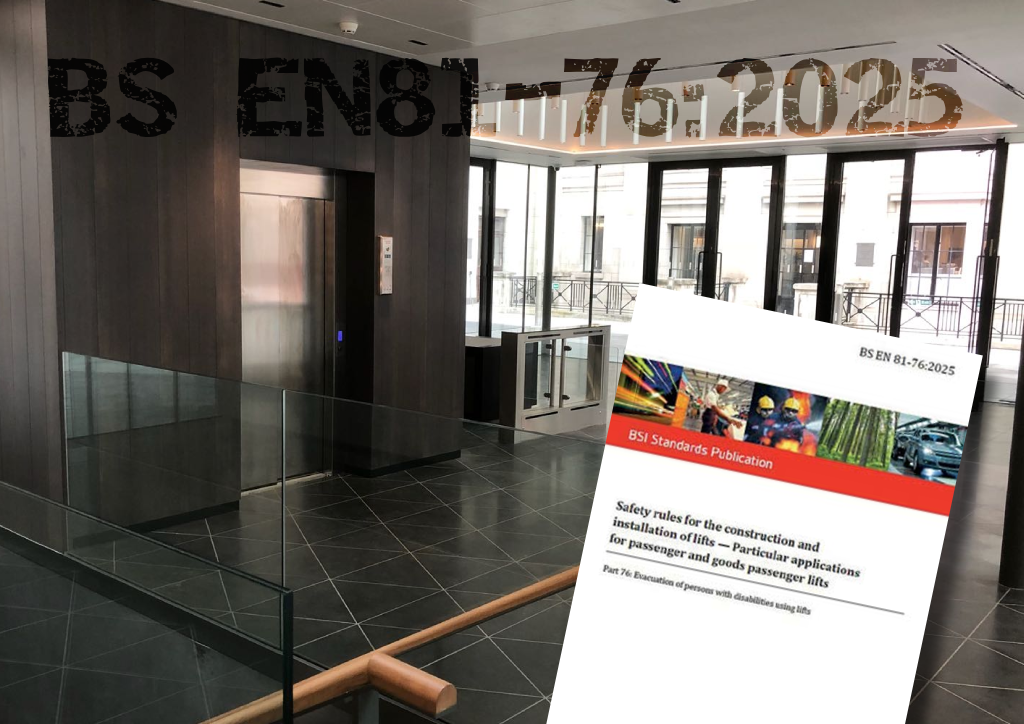
The end of July saw the publication of BS EN 81-76, the long-anticipated European standard for evacuation lifts designed for people requiring level egress. This long-awaited development represents a major milestone in inclusive building design and marks an important step towards safer evacuation options for those who rely on lifts for everyday access.
At TJ Lift Solutions, we welcome the introduction of this new standard and recognise its importance in guiding future lift design, installation and integration — ensuring that no one is left behind during an emergency evacuation.
Advancing Lift Safety and Accessibility
Before BS EN 81-76, the only framework for evacuation lifts was found in BS 9999:2017, which itself evolved little from BS 5588-8:1988. With limited prior guidance, the new EN 81-76 genuinely sets a state-of-the-art benchmark in lift design and operation.
The standard establishes a European-wide approach for how evacuation lifts should perform and operate, though it stops short of dictating building design. Instead, it sets out the building-related conditions that must be in place for a compliant and effective evacuation lift system. These include critical interfaces with fire protection, detection and alarm systems, and ventilation to ensure the lift remains a safe means of egress during an emergency.
Complex Implementation Requiring Collaboration
BS EN 81-76 introduces three possible evacuation lift operation modes and distinguishes between two levels of complexity:
- Class A – for low-rise buildings with simpler evacuation requirements.
- Class B – for larger or high-rise buildings requiring a more developed specification.
This makes BS EN 81-76 a technically challenging standard to apply, particularly given its reliance on coordination between multiple building systems. Successful implementation requires close collaboration between lift specialists, fire safety engineers, and building designers, as the lift’s safe operation depends heavily on signals and protection provided by the building itself.
National Guidance for UK Implementation
In the UK, the BS EN 81-76 version includes a National Foreword, offering additional guidance for applying the standard within the context of UK building regulations. This section reinforces that the safe integration of evacuation lifts depends on collaboration between all responsible parties — including those overseeing lift installation, building design, electrical systems, and fire safety.
Preparing for the Future
Implementing BS EN 81-76 will take time and coordinated effort across the lift and construction sectors. Beyond new installations, attention will soon turn to how existing lifts can be upgraded for evacuation use. Work is already underway on BS 8486-10, which will offer further guidance on verifying building conditions and ensuring compliance where full integration may not yet be achievable.
At TJ Lift Solutions, we are already aligning our approach to support clients with this transition. Our technical team continues to monitor the latest standards and guidance to ensure that all new installations and modernisations are designed with safety, compliance, and accessibility in mind.
Supporting Inclusive Design
The publication of BS EN 81-76 is more than a regulatory update — it’s a step towards a more inclusive built environment. It ensures that everyone, regardless of mobility, can safely exit a building during an emergency.
As lift specialists with expertise in design, installation, and modernisation, TJ Lift Solutions is committed to supporting building owners, architects, and contractors in implementing these new standards effectively.
To discuss how BS EN 81-76 may impact your next lift project, or to explore compliant evacuation lift options, contact TJ Lift Solutions today.